Dev Diary #4: At Your Command
A Closer look at Army management
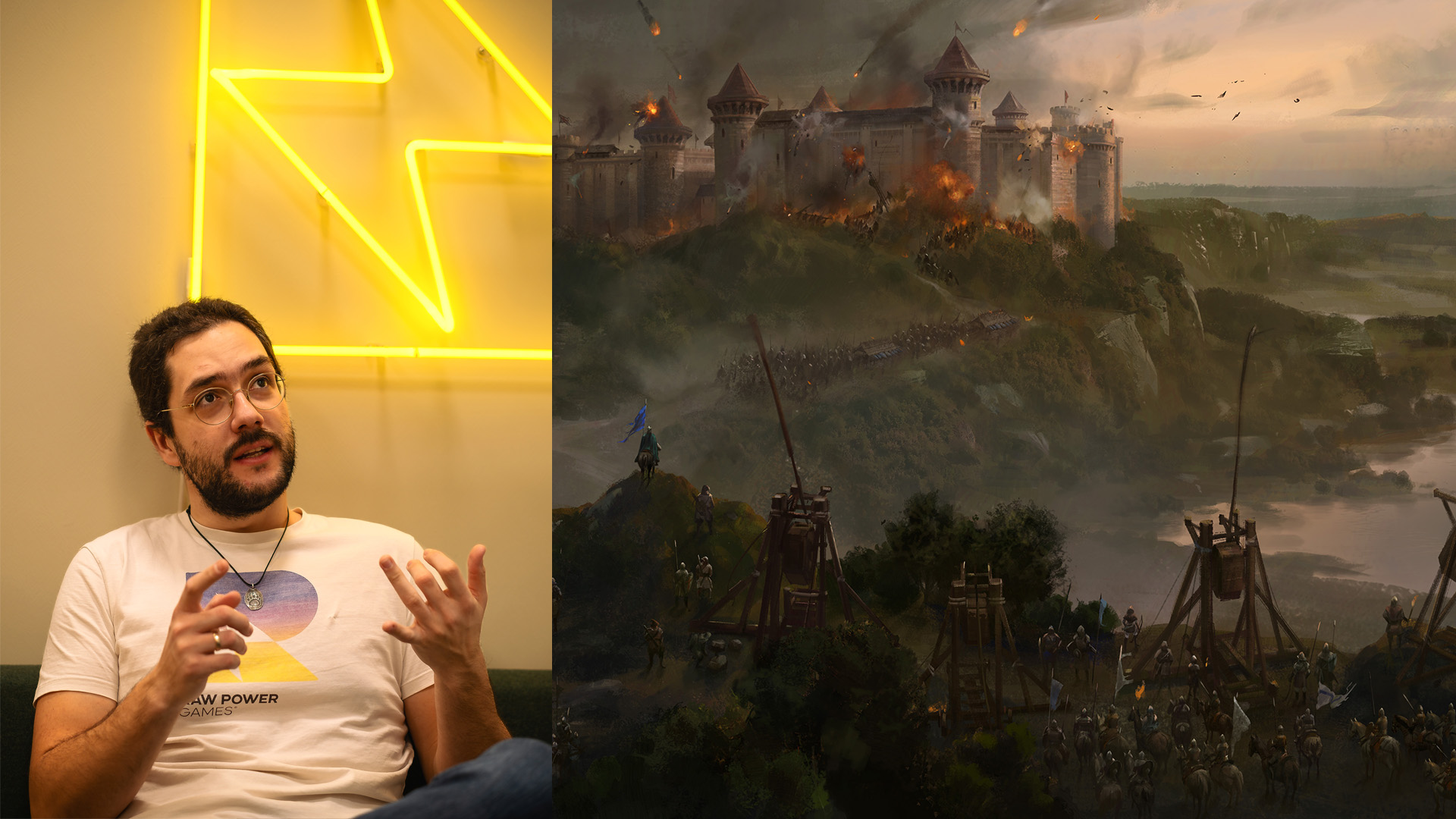
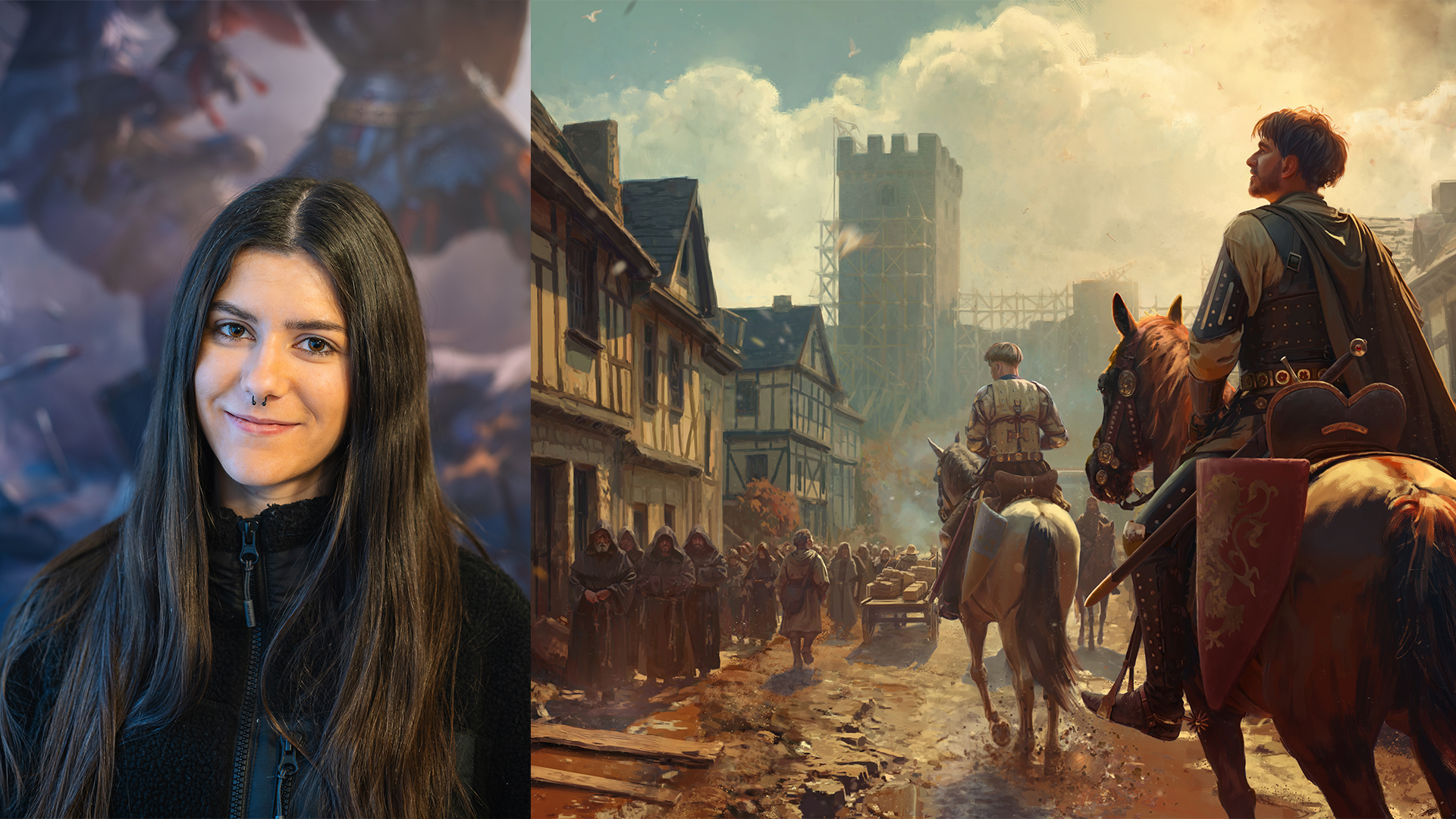
In our previous Developer Diaries, we've explored the politics and rivalries that drive conflict, and how battles play out in Chronicles: Medieval. This time, we're turning our attention to your army. Join Nikki Kuppens, Senior Game Designer, for a closer look at how you'll obtain, maintain and expand your army, alongside plenty of newly captured footage. As always, everything shown is still a work in progress.
Before we kick off the show we'd also like to share an update on our release plans.
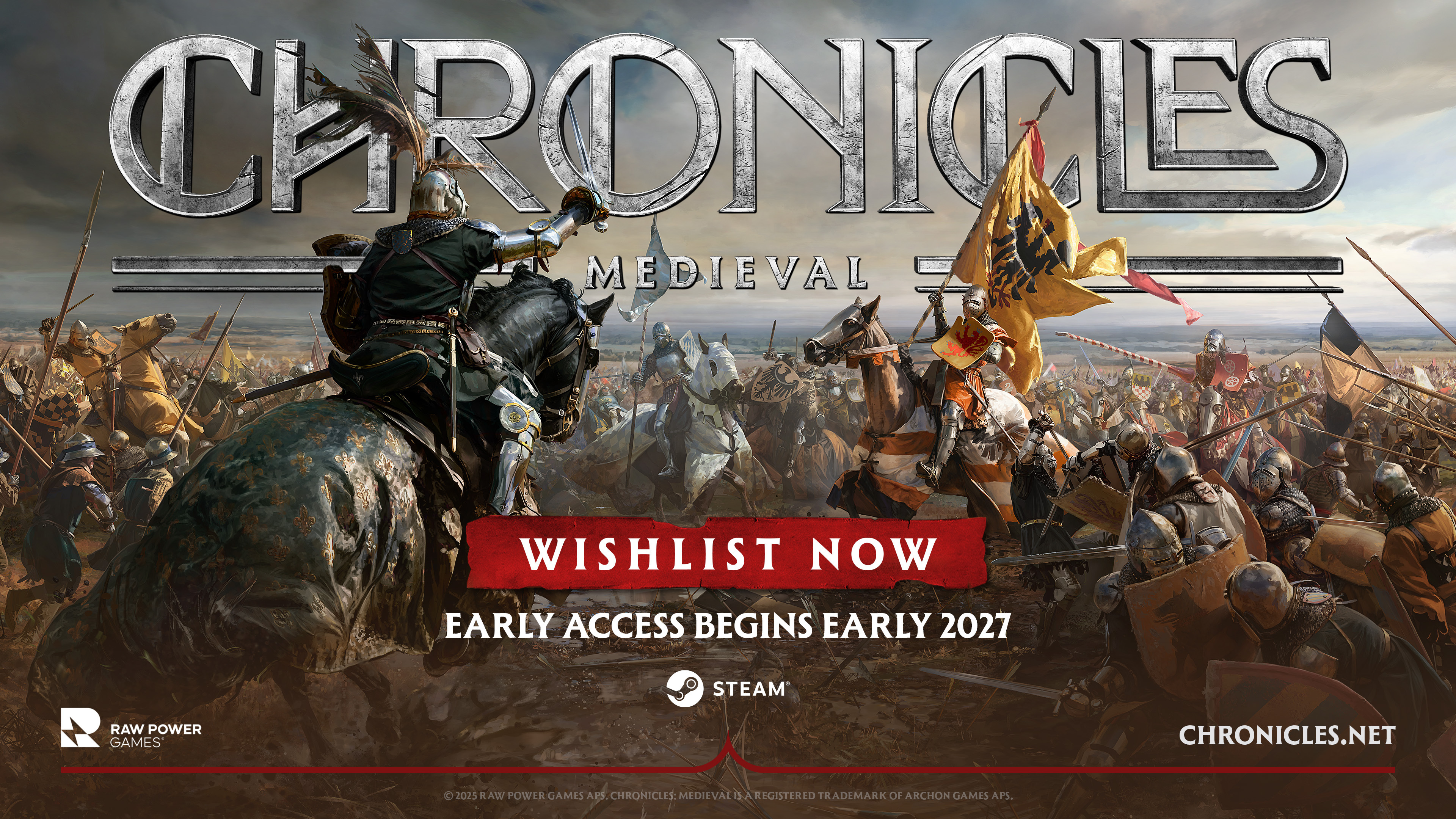
After carefully considering our development goals for our ambitious game, we've decided to move the Early Access release of Chronicles: Medieval to early 2027.
The additional development time will allow us to further refine the experience, strengthen core systems, and start our Early Access journey in the best possible place for both the team and the community. Thank you, as always, for your continued support.
Now, let's turn back to the matter at hand: managing your army in Chronicles: Medieval:
We also have a blog to accompany the video. So, if you're unable to watch it, or simply want a little more detail on army management you can dive into the written piece by Steven, Björn and Nikki below. Enjoy!
Introduction
Welcome back to another Developer Diary for Chronicles: Medieval. Last time we talked about the battlefield, including how to deploy, command and maneuver your units in battle. In this update we are focusing on the units that make up your army, which types of units there are, where you can raise them, how they gain experience and how they are promoted to more capable and resilient units over time.
We will first start with setting the historical context for our approach to units and here to do so is our very own Björn Rüther, our combat mocap supervisor and HEMA-enthusiast.
Historical Background
From Antiquity, with its sometimes gigantic armies, to the Middle Ages with their comparatively smaller forces, military service and methods of raising troops took many different forms.
The Middle Ages, however, should not be viewed as a single, uniform period. During the Early Middle Ages, nearly every free inhabitant of a realm could, in principle, be called upon for military service. By the High Middle Ages, warfare had increasingly become the domain of the heavily armed mounted knight (Panzerreiter) - a professional mounted warrior elite. This changed once again during the Late Middle Ages, the era in which Chronicles: Medieval is set.
From around 1300 onward, and continuing throughout the 15th century, Europe saw the gradual development of a far more complex military system. Obligations of military service became more structured, and the use of both rural and urban populations as infantry is well documented.
Emperors, kings, and rulers were far from all-powerful. In particular, the Holy Roman Empire depended heavily on the cooperation of its princes and subjects, who were themselves eager to prevent the emperor from accumulating absolute authority. Yet throughout France, England, and the imperial territories alike, one institution united the ruling nobility: the feudal system. Through oaths, alliances, and mutual obligations, nobles pledged military support to one another in times of war. This intricate hierarchy extended from the highest ranks of the nobility down to towns and villages, forming a politically interconnected system of lordship.
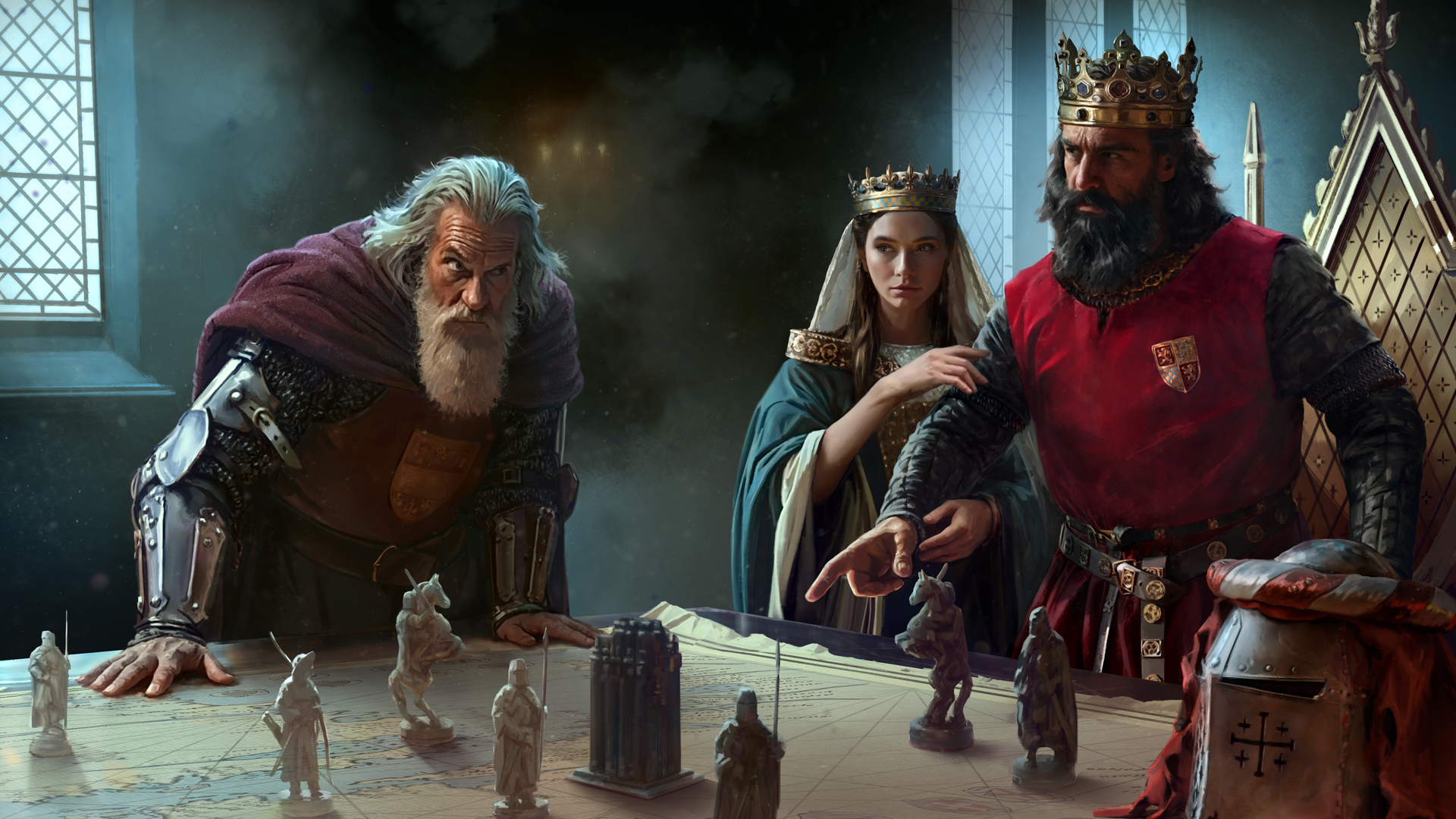
The ruler of a realm promised protection to his vassals, while the vassals pledged loyalty and military service in return. Standing armies, as we understand them today, did not yet exist. Early attempts at creating permanent military forces appeared only in the mid-15th century, such as the French compagnies d'ordonnance established by Charles VII. Even then, truly permanent armies would not emerge until the late 16th century, following military reforms such as those introduced by the Dutch Staatholders of the House of Orange-Nassau (which is still the royal house of the Netherlands today).
As a result, the strength of a ruler's alliances was the most important factor in raising an army during the Late Middle Ages.
As mentioned the rural and urban population was mustered by the immediate lord of the region and typically called to serve only for a limited period. A commonly cited duration is forty days. Alongside these levies, the nobility contributed their household troops - well-equipped elite fighters known as men-at-arms. These men often came from the lower nobility themselves and fulfilled their feudal obligations by serving alongside their lord. Among them were also knights and members of the higher nobility, who frequently fought on the front lines together with their vassals.
Naturally, not every noble was always able to provide the predetermined number of troops, horses, wagons, and supplies. Fortunately for many rulers, the Late Middle Ages also saw the widespread rise of mercenary service, allowing those with sufficient financial resources to recruit additional forces. As early as the 14th century, Northern Italy already had a flourishing mercenary market, where German men-at-arms and knights offered their services to the Italian city-states or to the Papacy- the same region where the famous Condottieri would later emerge. Mercenaries, however, also posed significant problems during peacetime. In France, for example, unemployed companies of soldiers known as the Routiers became notorious for pillaging the countryside and caused considerable trouble for the French crown.
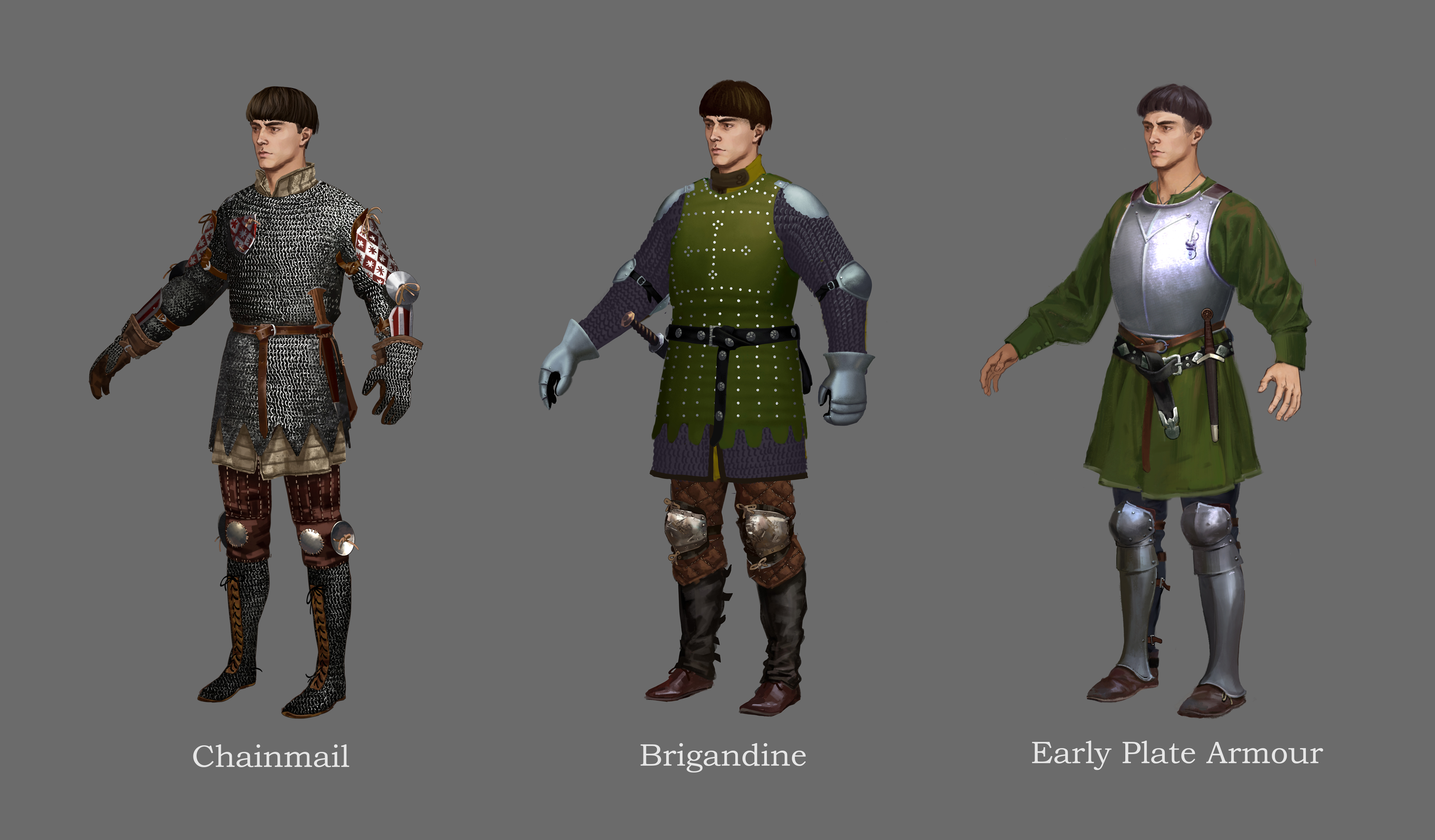
The ways in which armies could be assembled were therefore remarkably diverse. At the same time, the equipment and battlefield roles of different troop types evolved rapidly throughout the 14th and 15th centuries. Where mail armor had once dominated among mounted warriors during the High Middle Ages, the late 14th century witnessed the widespread introduction of plate armor components, improved helmet designs, and increasingly effective weapons.
In Chronicles: Medieval, we aim to capture these developments in an engaging and plausible way by featuring a wide variety of troop types, emphasizing their regional differences, and reflecting the continuous evolution of weapons and armor throughout the Late Middle Ages.
Now over to Nikki Kuppens, who is our Senior Game Designer responsible for all things progression, which includes how to obtain, maintain and expand your army.
Units
As ever, please note that the systems described here form a core part of the Chronicles: Medieval experience, but their scope and values are still in active development and subject to change and rebalancing.
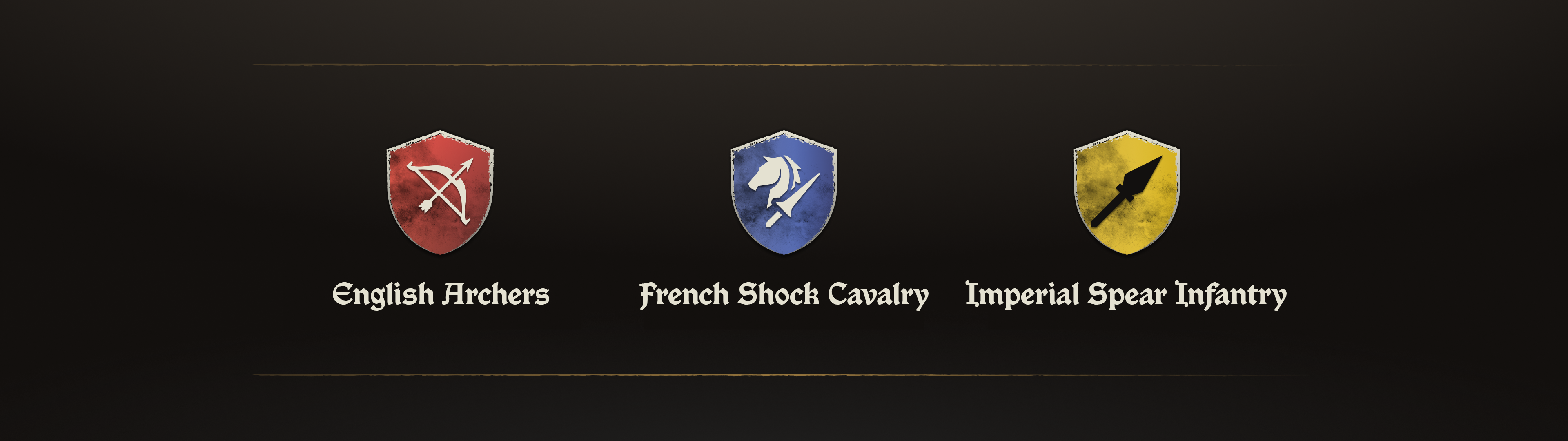
Units are a permanent body of men who are similarly equipped and fight together under the same banner. They are presented as one entity in your army overview, with a name and current troop count, but appear as individual troops on the battlefield. Every main faction will have their own dedicated Levy, Household and Mercenary units, each with completely unique progression trees. While all trees include melee and ranged troops, infantry and cavalry, each tree is tailored towards the historical strengths of the faction it belongs to. The English have exceptionally skilled bowmen, while the French are known for their fearsome cavalry, and the Holy Roman Empire for their tough melee infantry.
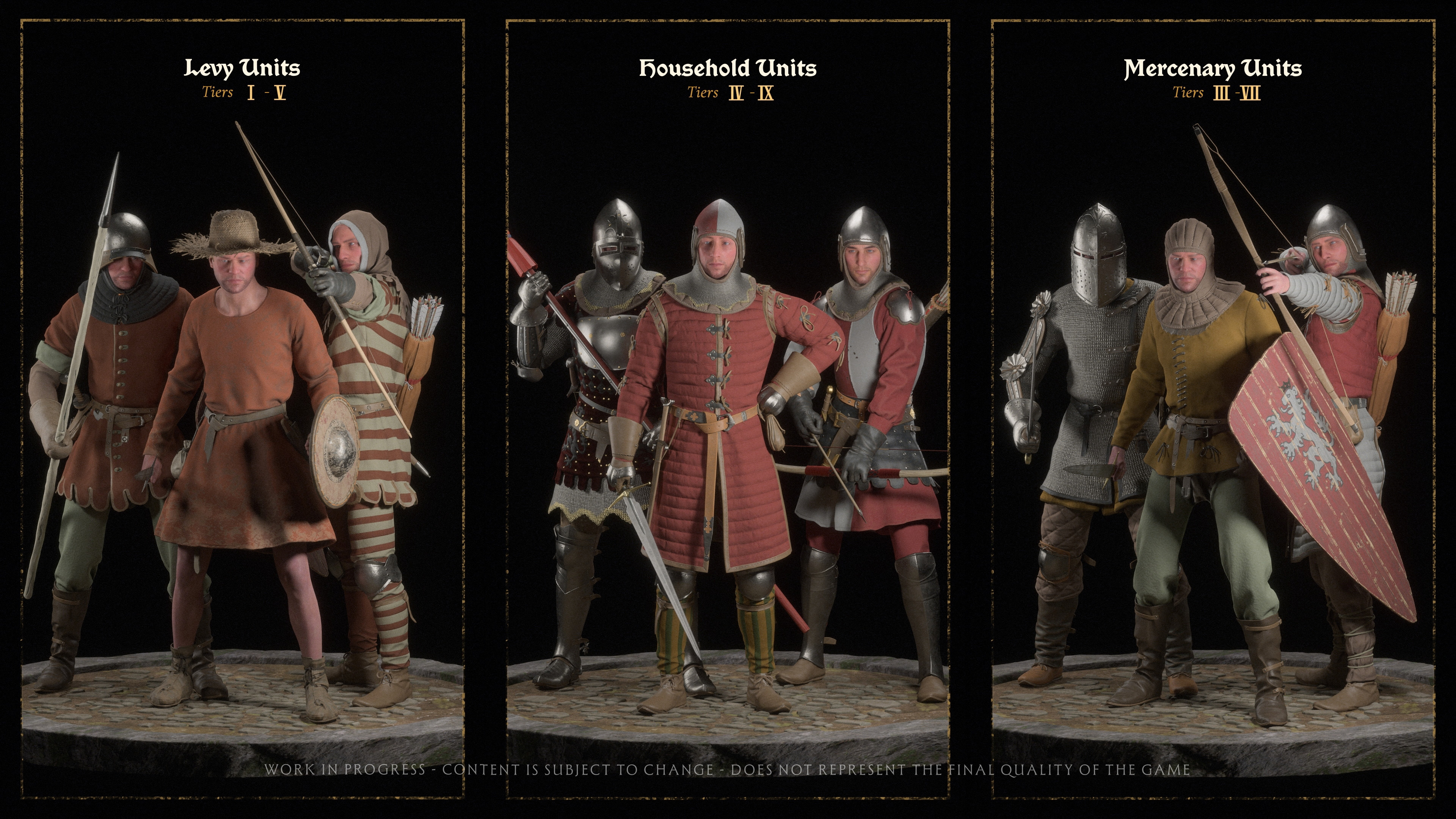
A competent commander will use Mercenaries to compensate for weaknesses in their Levy and Household lineup, but the downsides of Mercenaries are that they are expensive and their morale is more easily affected than that of the Household line. As an example, adding English Mercenary archers to a French army is a great way to improve ranged potency of your army. Similarly, reinforcing a Holy Roman Empire army with French Mercenary cavalry ensures a strong vanguard of both melee infantry and cavalry. It is up to you to experiment with different combinations of units to build an army that suits your playstyle, as long as you can afford their recruitment and upkeep costs.
Troop Types, Tiers & Stats
Every node inside a unit’s progression tree represents a troop type and in Chronicles: Medieval the troop types are classified into power tiers from 1 (least powerful) to 10 (most powerful). The power tiers are defined based on category (Levy, Household, Mercenary), role (melee or ranged, infantry or cavalry), equipment (armor, weapons and ammunition) and stats (see below). As you upgrade a unit through its progression tree these may all change.
Levy units are typically recruited at tier 1 and can be promoted up to tier 5. Household units have more training and better equipment, so they start out at tier 4 and can advance to tier 8 or 9, depending on the specific progression tree. This also means that a fully upgraded Levy unit at tier 5 has a fighting chance against a low tier Household unit. Mercenaries sit somewhere between Levy and Household tiers, starting at tier 3 and ending at tier 7.
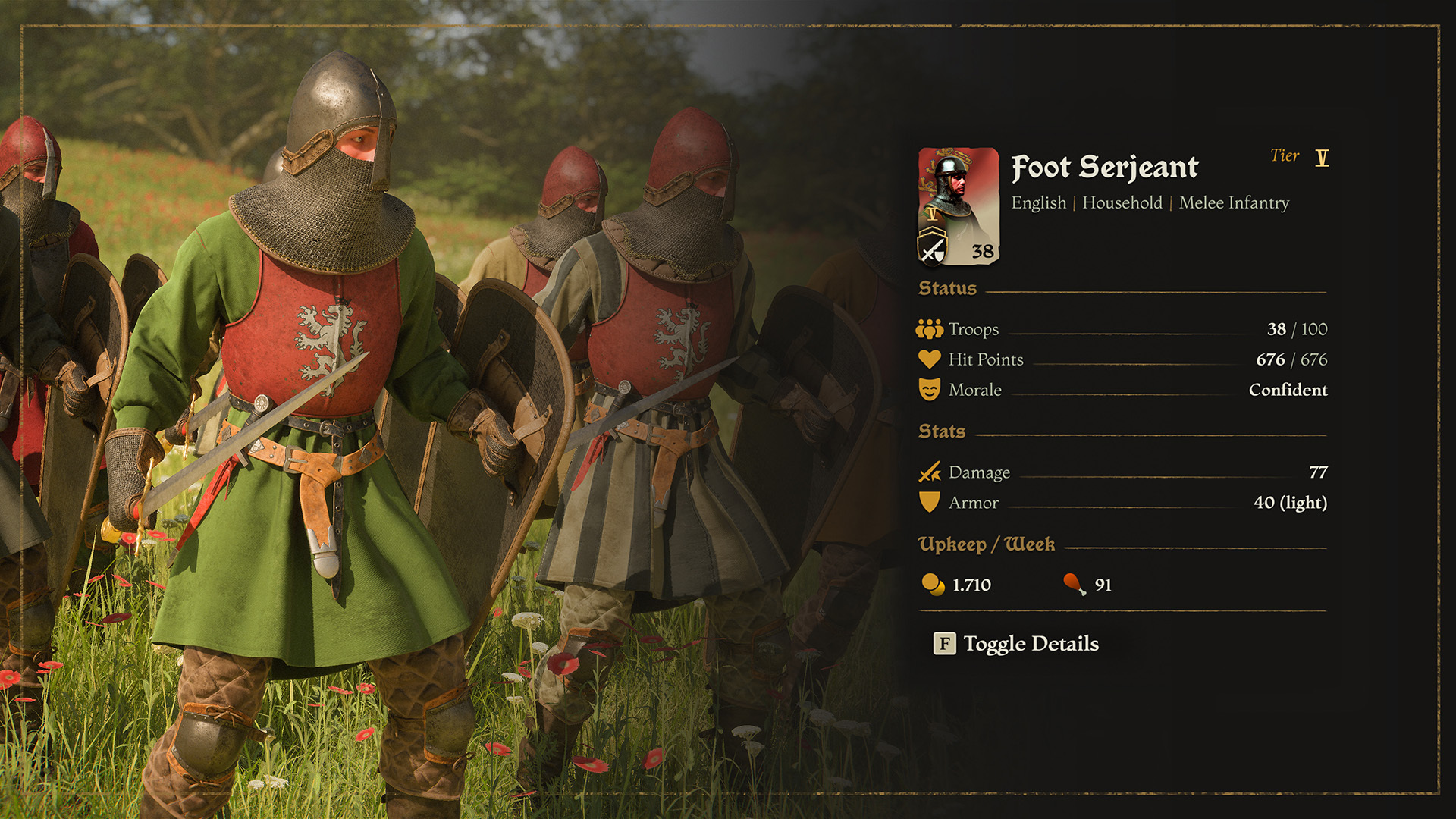
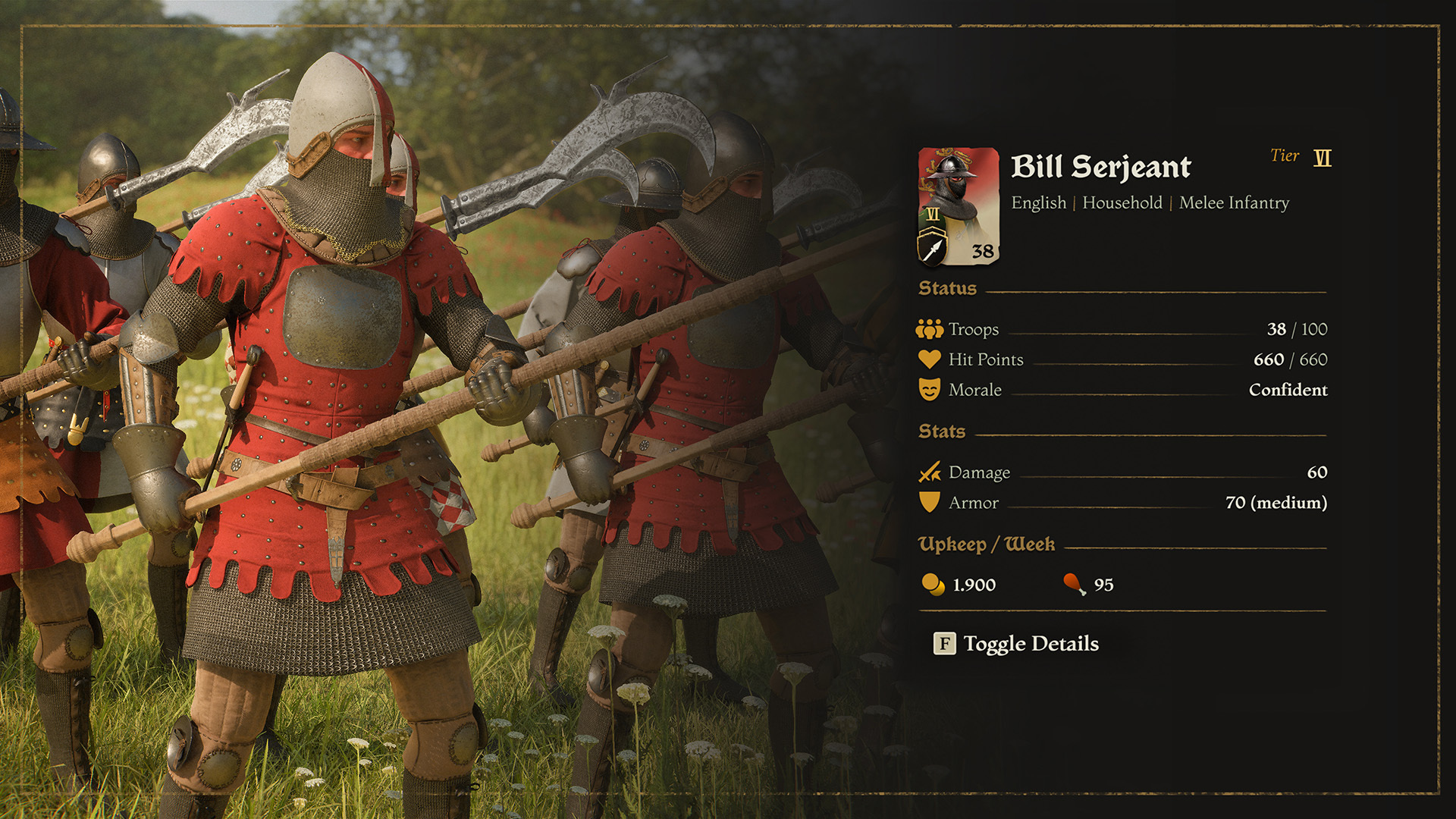
Below is an example of a unit card, which details its stats, tier, general equipment and category. This unit is currently a tier 7 melee infantry type, from the English Household line. In Chronicles: Medieval, unit names are somewhat anachronistic and French and Holy Roman Empire units will be named in their native languages.
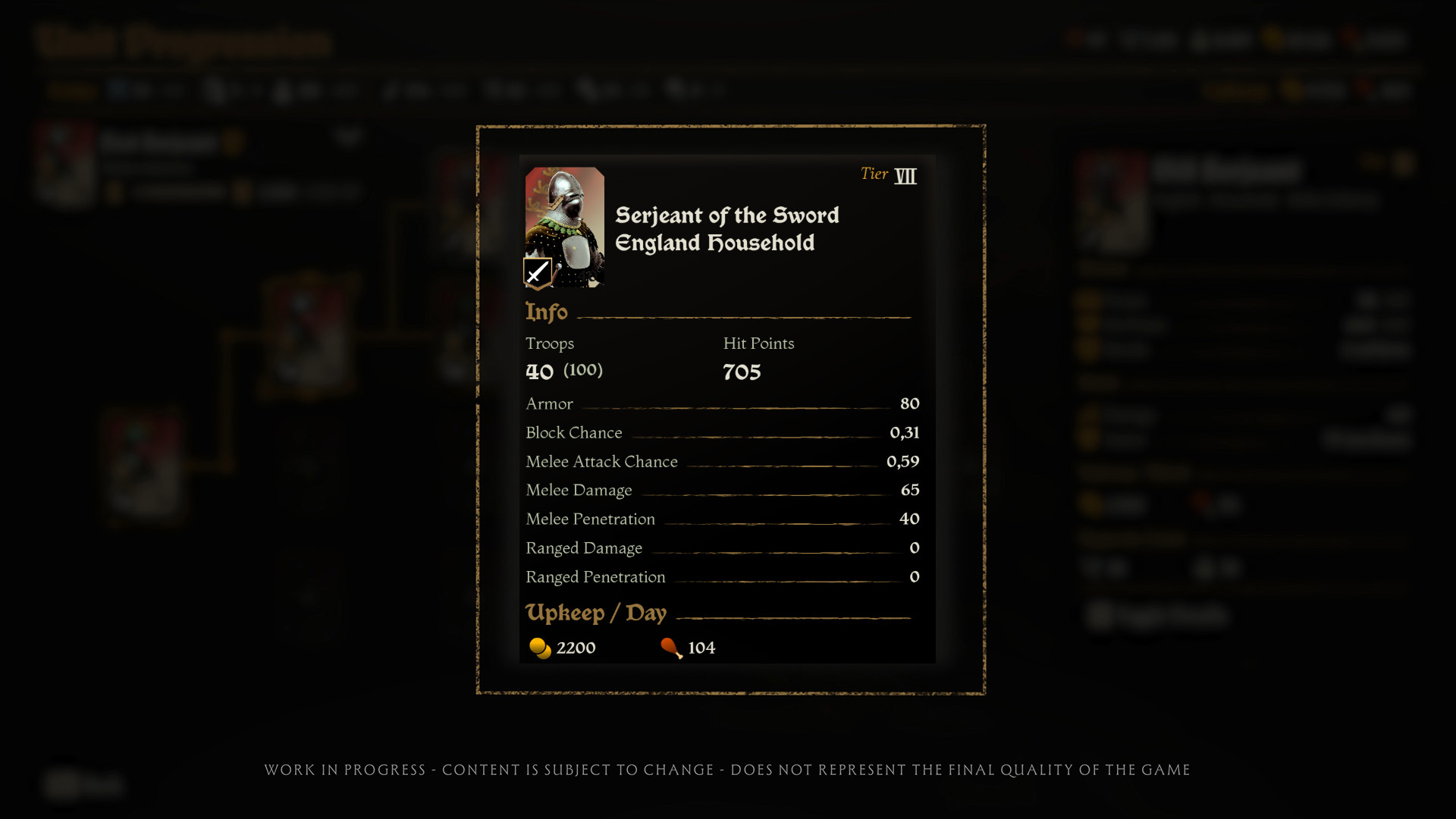
Base:
- Troops: The current number of active troops in the unit. The number to the right indicates the maximum possible troop count.
- Hit Points: Total damage a single troop can absorb before dying. Melee units are durable, while ranged units are fragile.
- Melee/Ranged Damage: Base weapon damage dealt. Units without a primary melee weapon will automatically use a sidearm in close combat.
- Armor: Damage reduction. Higher armor increases the required penetration for incoming attacks to do damage.
Details:
- Melee/Ranged Penetration: The ability of the unit's weapon to bypass enemy armor.
- Attack Chance: The probability that a troop's next action will be an offensive swing.
- Block Chance: The probability that a troop's next action will be a defensive block.
- Cohesion: Cohesion represents the trust, loyalty and mutual support developed between soldiers which make them fight as a team instead of individually
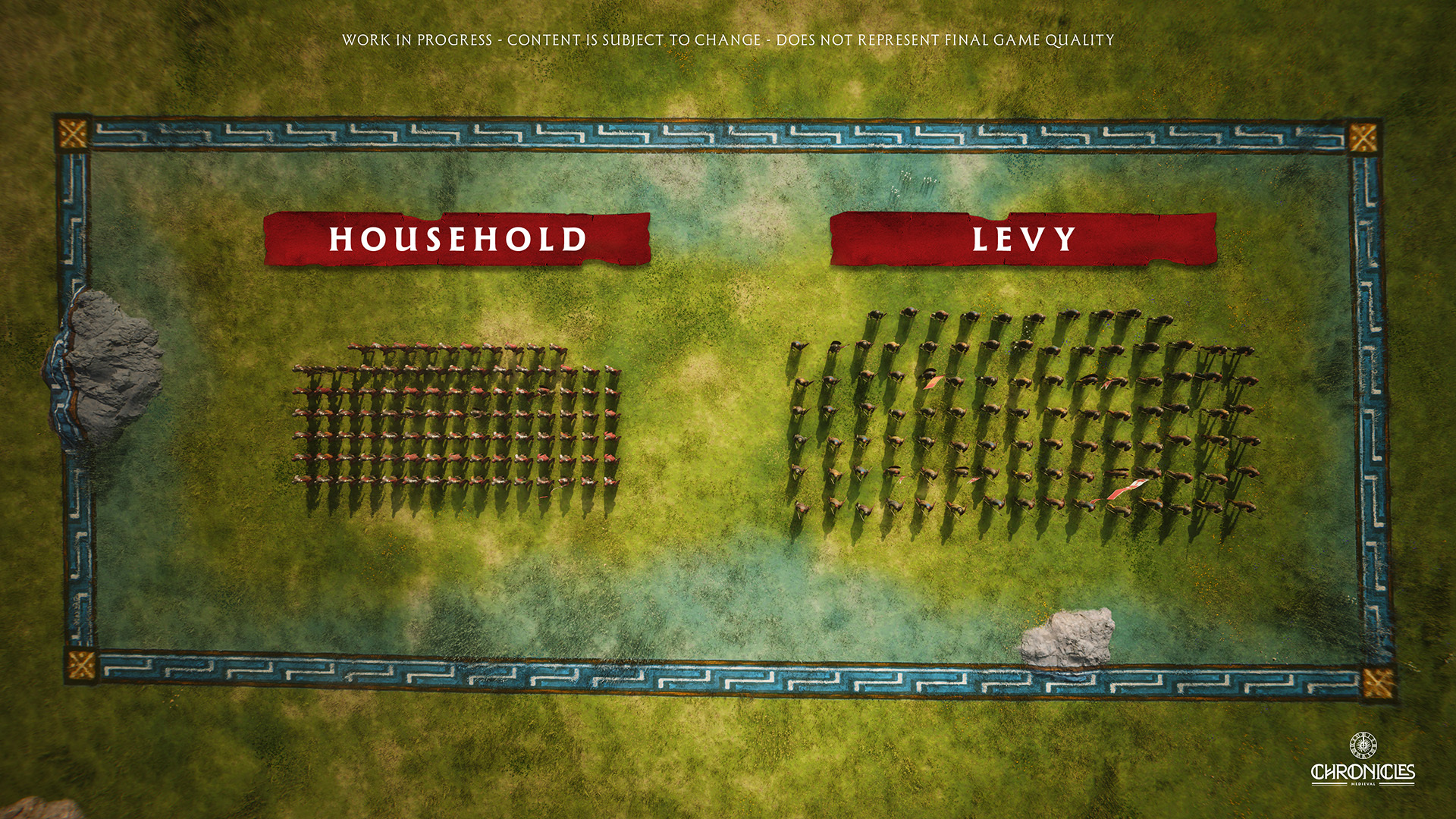
In Chronicles: Medieval, you will need to seek out new recruits for your army and there are two methods of doing so. The first is to add new units to your army, in order to expand your army’s maximum size and strength. The second is to replenish and reinforce your existing units with additional troops. Both can be done by talking to quartermasters at locations all across the Exploration Map. Quartermasters primarily reside in settlements and castles and allow you to inspect which units and troops are available for recruitment and replenishment.
Recruiting Units
On occasion, a collection of troops already organized into a particular type of unit will offer its services. Levy units can typically be recruited at settlements, with the size of a settlement having an effect on which tiers can appear for recruitment. Household units on the other hand must be recruited at castles. The functional buildings (e.g. barracks, stables, blacksmith) present there influence what roles and tiers of units may become available. Additionally, the culture of the region where the settlement or castle is located further determines exactly what units can appear there. Recruitable Levy and Household units will match the culture of the region, while Mercenaries will do the opposite. In English regions you will find English Levy and English Household units, while French or Holy Roman Empire Mercenaries may also offer their services there. English Mercenaries, however, only appear abroad in foreign lands.
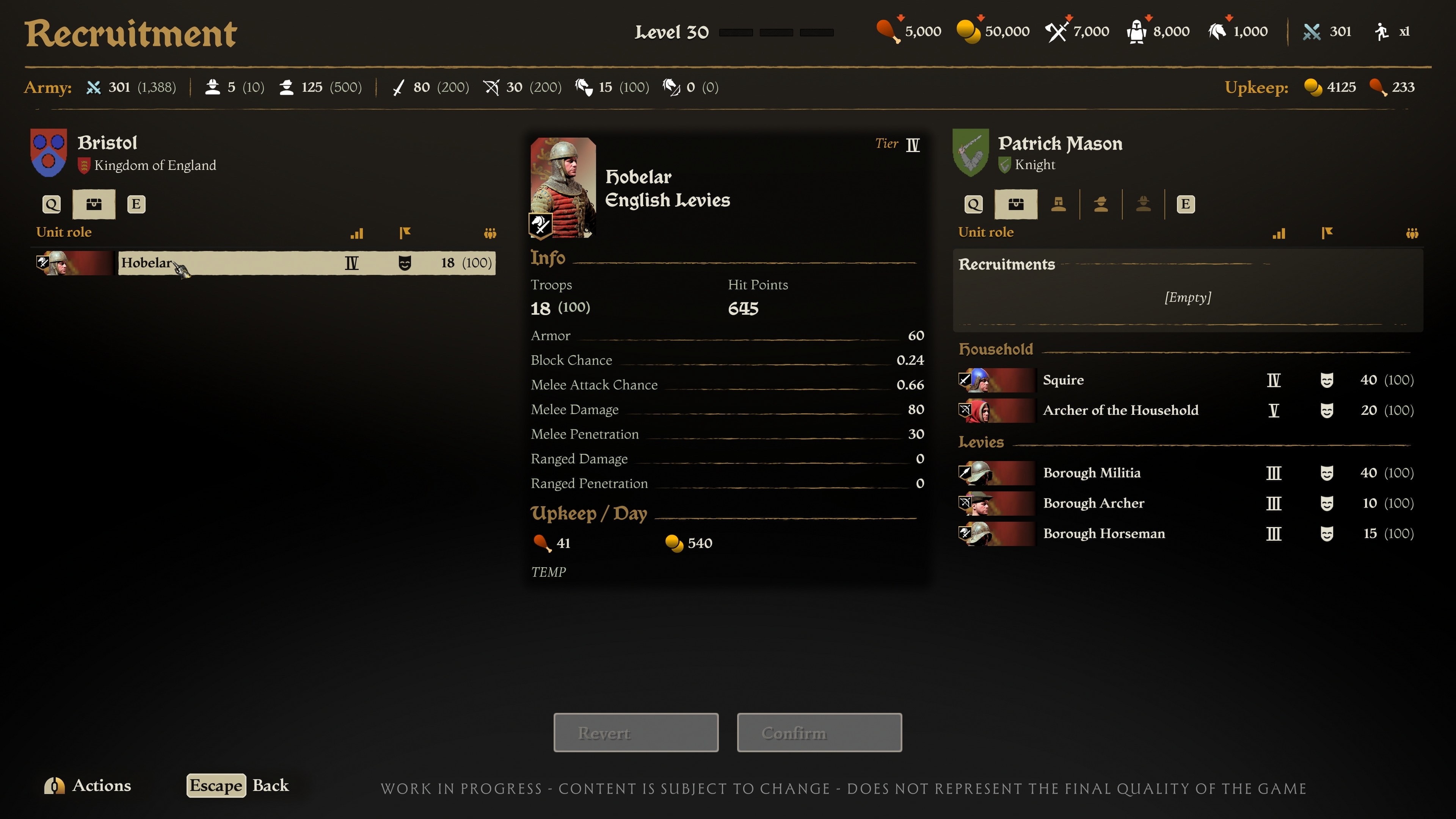
Note that at the start of the game you may not have access to all unit categories, as they are either too costly or will frankly refuse to follow an unknown commander. The typical player journey will see you relying heavily on Levy units at the beginning of the game, Mercenaries towards the mid-game and Household in the mid- to late game. As recruitment and upkeep costs vary by unit category, troop type and tier, fielding a big army too soon without solid finances can really ruin your day. Historically, failing to adequately pay mercenaries had serious consequences for the city states of Florence, Siena and even the Papacy itself. We are balancing recruitment and upkeep costs so that fielding a Household-only army of the maximum size will be very expensive, but not impossible. Instead, you may prefer a more balanced army composition that includes Levy and Mercenary units.
Replenishing Troops
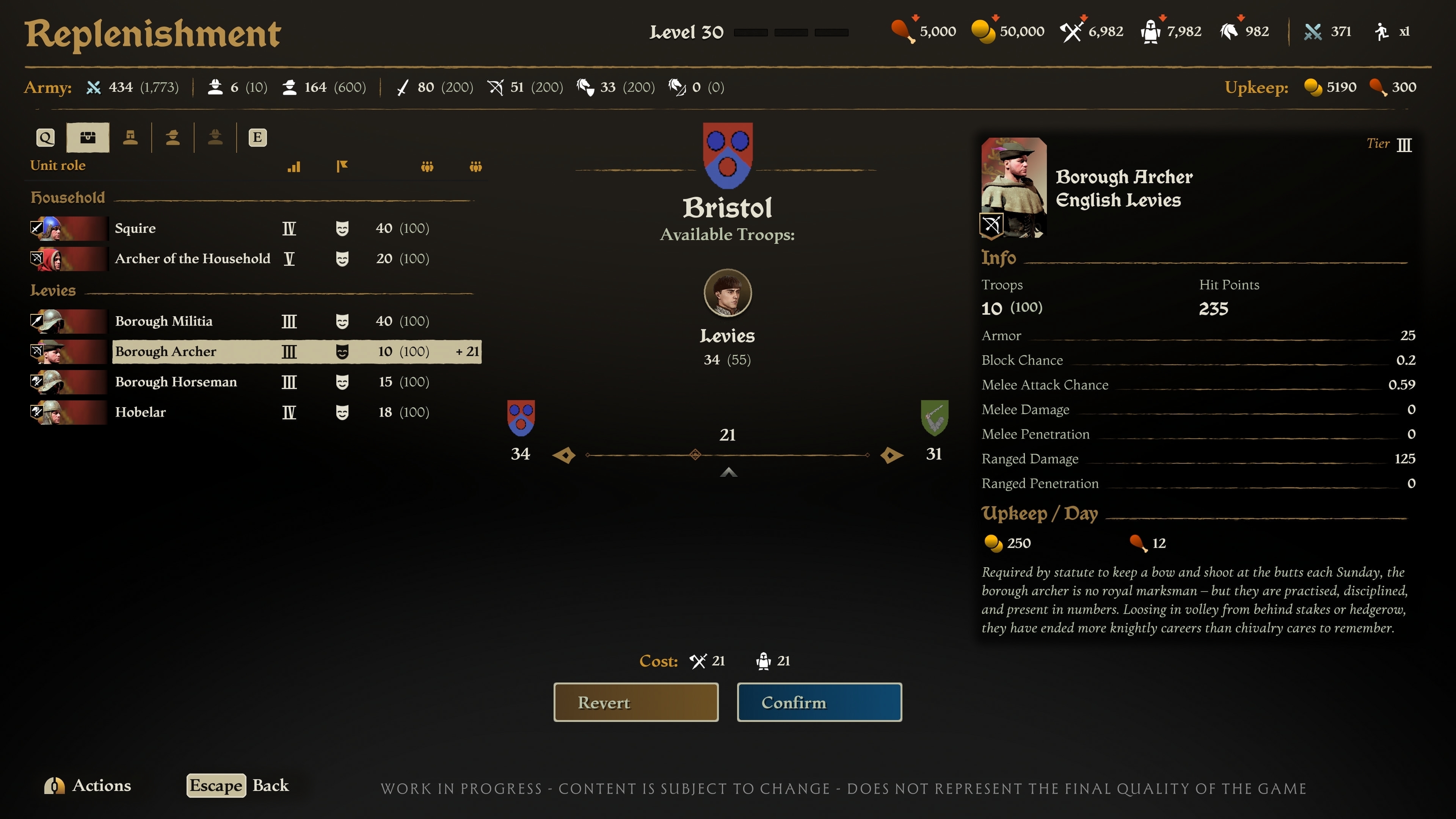
When new units are acquired, they are usually not at full strength, meaning their initial troop count is below their maximum size. Their numbers will deplete due to battle, which further increases the need to seek out quartermasters in order to replenish your troops. Each unit category has a matching replenishment troop resource, available at specific types of locations similar to units, so you know where to go to bolster Levy, Household or Mercenary units specifically. These troop resources are instantly added and type-agnostic, meaning they can be used to replenish any category-matching unit, regardless of culture, role or tier, but the per-troop recruitment costs will vary based on what unit you add them to. These costs are identical to what a new unit of that type with that number of troops would cost, involving arms, armor and horse resources.
Availability & Progression
Each location that provides recruitment opportunities only has a limited number of troops and units present. Other army commanders also visit these same locations and may reduce the available pool of recruits, which influences what you have access to. Recruitment offers do reappear with time, resetting globally every in-game week. This means that you may not always be able to recruit back to full army strength, especially after taking heavy losses, forcing you to pass the time or visit other locations. Several other factors also affect what is on offer, such as your renown or the prosperity or functional buildings of a location, which can modify unit spawn chances, initial unit sizes, troop tiers and replenishment pools. At Early Access launch, functional buildings can only be constructed and upgraded in castles, which will later be expanded to settlements.
Additionally, while winter warfare did happen, the agricultural calendar with the sowing and harvesting season, alongside limited options for foraging for food during winter, meant that Medieval armies were less likely to fight during winter. The gradual introduction of paid professional armies eventually made year-round warfare more realistic. At Early Access launch, seasonal changes will have limited impact on gameplay and mostly affect recruitment availability, but this is something we intend to expand during Early Access.
Progression
To develop and improve a unit through its progression tree, it must gain experience and the primary source for that is participating in battle. The amount of experience earned is based on performance, with units that are passive during battle receiving less than units that inflict losses and take casualties. Once a unit has earned enough experience, it qualifies for promotion to the next tier. Levy, Household and Mercenary units have different experience requirements, to reflect their level of training and ability to improve. The experience required will also increase after each promotion.
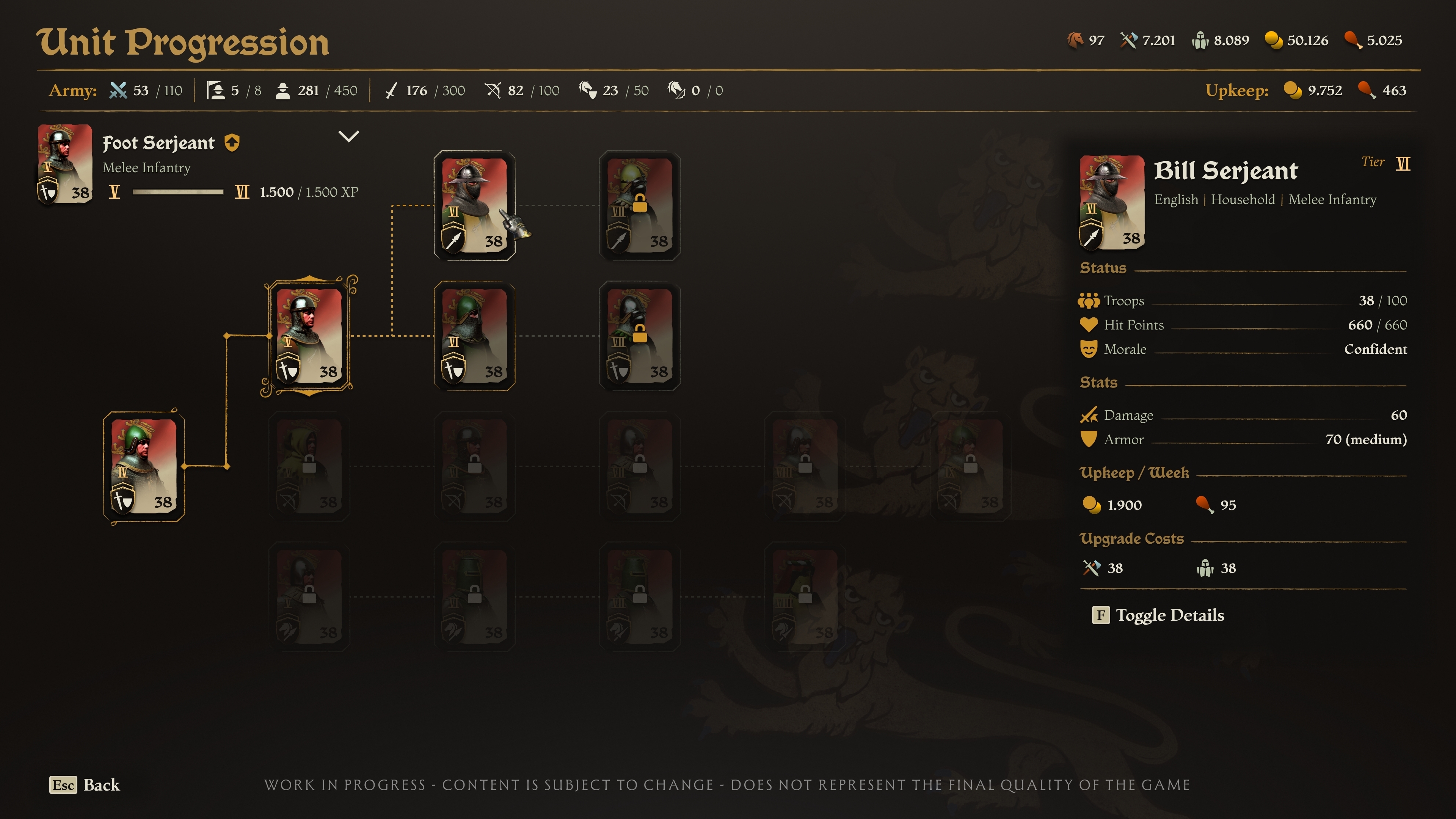
Promotion will cost a variety of resources, depending on the unit’s category and what tier and role they are upgrading to, and scaling with the number of troops currently in the unit. Melee and ranged infantry require different amounts of arms and armor, while cavalry also has a need for horses. Additionally, Household units are more expensive to upgrade than Mercenary or Levy units. More powerful units also require more upkeep, with differences between roles and categories, so it’s important to consider who, how and when to upgrade.
Promoting a unit turns it into something new entirely, making them more deadly and resilient as their stats increase. They may also gain better equipment and learn new formations. At certain forks in the unit’s progression tree, a choice can be made between further developing troops in their current role, specializing them into particular weapon types (e.g. sword vs. polearm) or changing their role entirely (e.g. infantry to cavalry, melee to ranged). Whenever you upgrade a unit, its troops will undergo a visual transformation as well. Each troop type in every unit’s progression tree will have a unique name and presentation, with weaponry and armor that reflects their role, strength and standing.
The Foot Serjeant is a tier 5 melee infantry troop type available in the English Household unit’s progression tree. When promoted to tier 6, it can either turn into the Sword Serjeant or the Bill Serjeant. The Sword Serjeant’s purpose is similar to its predecessor, but has better equipment and stats. The Bill Serjeant, however, is equipped with heavier armor and a bill polearm, making it better suited for dealing with cavalry.
Army Size
In addition to improving individual units, you may also increase the maximum number of units in your army. When starting out, you can only command a few units and deciding on army composition is an important consideration. That remains true as you increase your character’s skill as a commander and unlock up to 10 unit slots, as well as the ability to field larger units by increasing their maximum troop count, up to about double the initial value. This means in the beginning you could have two Levy units under your command with 50 troops each, which in the late game grows to a powerful army composed of varying categories and roles with a 100 troops in each unit. Eventually, you’ll be able to lead a thousand men into battle. As long as you can pay and feed them.
Morale
Battles rarely lasted until only one side was left standing, with troops fleeing the battlefield long before. Morale breaks before bodies do and as such, it is an important unit property both on and off the battlefield. The morale brackets used are the same inside and outside of battle, except for the Inspired state being achievable only during a fight. A unit’s morale status is carried into battle, where it can fluctuate depending on how the battle unfolds, and persists at the end of the fight.

Outside of battle, it’s important to keep your troops happy and provide them with food and pay. Failing to do so will lower their morale and low morale will eventually lead to desertion. The unhappier your troops are, the more will decide to leave your army periodically, as well as causing them to flee sooner during a battle. No desertion will happen when a unit is in the Confident bracket, but it will start in Concerned and will get progressively worse through Wavering and Broken. The only remedy is to increase morale, by consistently providing upkeep in full and to win battles decisively as an inspiring commander.
Closing Thoughts
That covers the core of how units and armies work in Chronicles: Medieval. From the moment you first recruit a handful of raw levies, to the day you field a seasoned army capable of changing the course of a war. It is a system built around choice at every level: which units you recruit, how you develop them, which gaps you plug with mercenaries, and how you keep the whole force fed, paid and willing to fight.
What we hope comes through is that army building is not just a numbers game. Morale ties your fighting strength to how you treat your men day to day. Recruitment ties your options to where you are and who controls the land. Experience ties advancement to actual performance in the field. These threads are meant to pull together into something that feels like running a real military force, rather than managing a spreadsheet.
There is still a great deal to share on the subject of battles themselves, and we will get to that in another update, but in the near future we will dive deeper into the physical world of Chronicles: Medieval and the Exploration Map that represents it. For now, we hope this gives you a clearer picture of the army you will be building and the decisions that will define it. We’ll also be at Gamescom 26, so keep your eyes open for more news from us while we’re in Cologne. There’s plenty more to come!

.jpg)
.jpg)

.jpg)