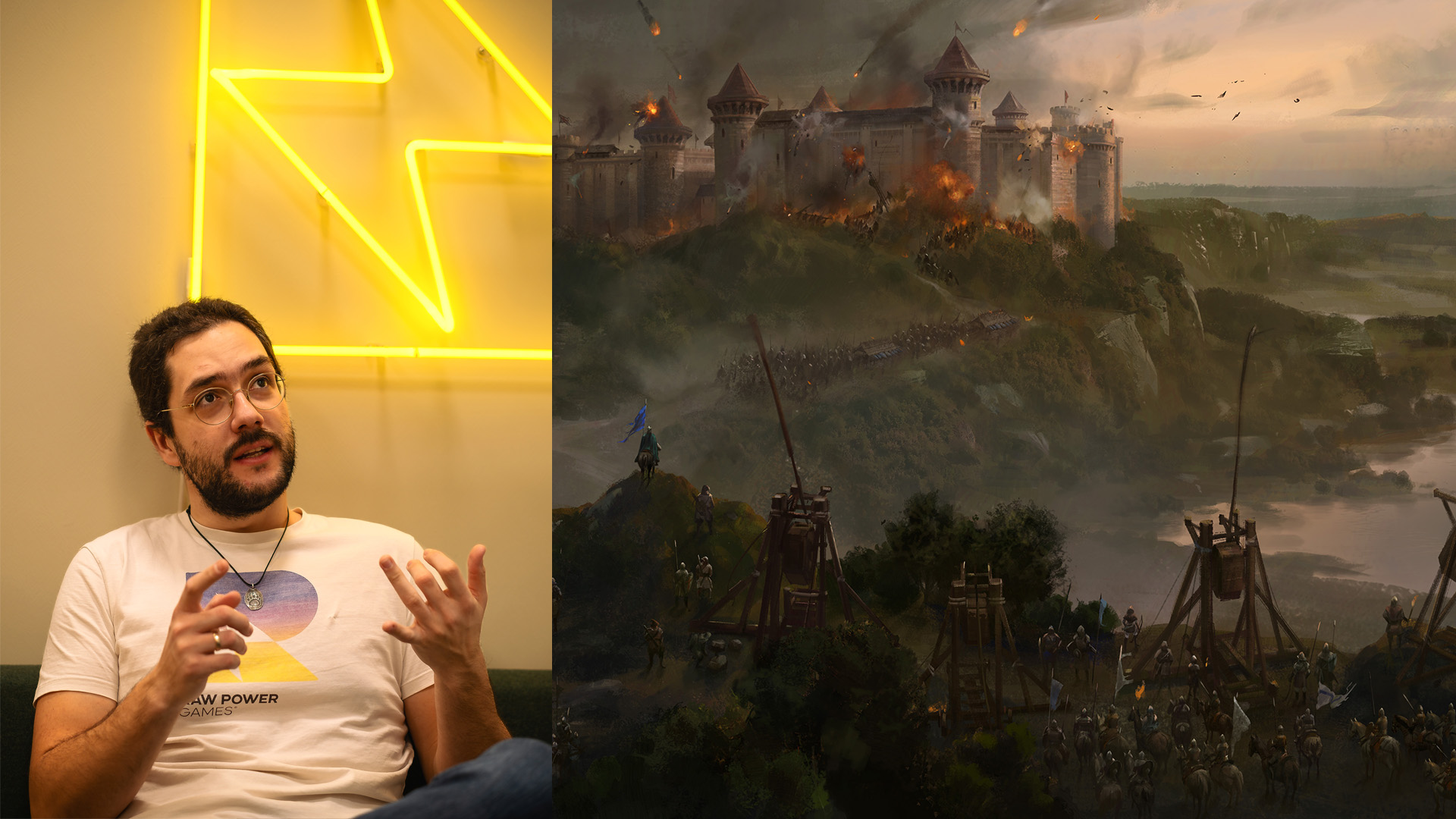
Dev Diary #2: Lords, Power, and War
Welcome back to our second Developer Diary for Chronicles: Medieval. In this entry, we’ll be taking a closer look at the systems and layered mechanics that shape the living world of the game. From the foundations behind simulation and immersion to the philosophy guiding their design.
But before we dive into the details, our senior writer Steven will give a short historical preamble on the thinking and inspirations behind these systems, before senior designer Álvaro walks us through how they come together in-game:
Historical preamble
Hello! I'm Steve, senior writer on the project, and before I hand over to Álvaro to walk you through the systems that animate our world, a few words on why those systems look the way they do.
The medieval world was not a kingdom in the modern sense. There was no Whitehall, no civil service, no standing bureaucracy stamping the king's will onto every village. A king in 1313 ruled, in practice, only as far as his most powerful vassals were willing to ride out for him -and those vassals ruled their own lands much the same way. Power flowed downward through bonds of homage and upward through bonds of obligation, and the whole structure was held together less by law than by personal loyalty and the ever-present threat of revolt.

Consider that the king himself had no fixed capital in the way we would understand one. The royal court was more of a traveling society, a great moving household of clerks, cooks, hounds, wagons, and armed men, processing from manor to manor and abbey to abbey, eating its way through the countryside and dispensing justice as it went. To be governed, in 1313, often meant waiting for the king to arrive in person -and to govern meant being, almost constantly, on the road. A realm was not a map. It was a network of relationships, walked and re-walked, year after year, by the people who held it together.
This is the texture we have tried to capture. A faction in Chronicles: Medieval is not a monolith but a constellation of individual lords, each with their own ambitions, grudges, and calculations.
With that, over to Álvaro.
Introduction
Hi everyone! I'm Álvaro, senior designer, and today I'll be introducing you to some of the systems that govern the world of Chronicles: Medieval.
These systems provide the context for the battles, challenges, and activities that the player - and every other character - will undertake over the course of the game.
By way of background, medieval societies were highly stratified not only among the peasantry, the clergy, and the nobility, but also within each of those groups. A person's birth, and only rarely their own actions, would dictate their place in society and their duties to it for life. How one addressed one's superiors and inferiors was ingrained from an early age, and any transgression was an affront to honour.
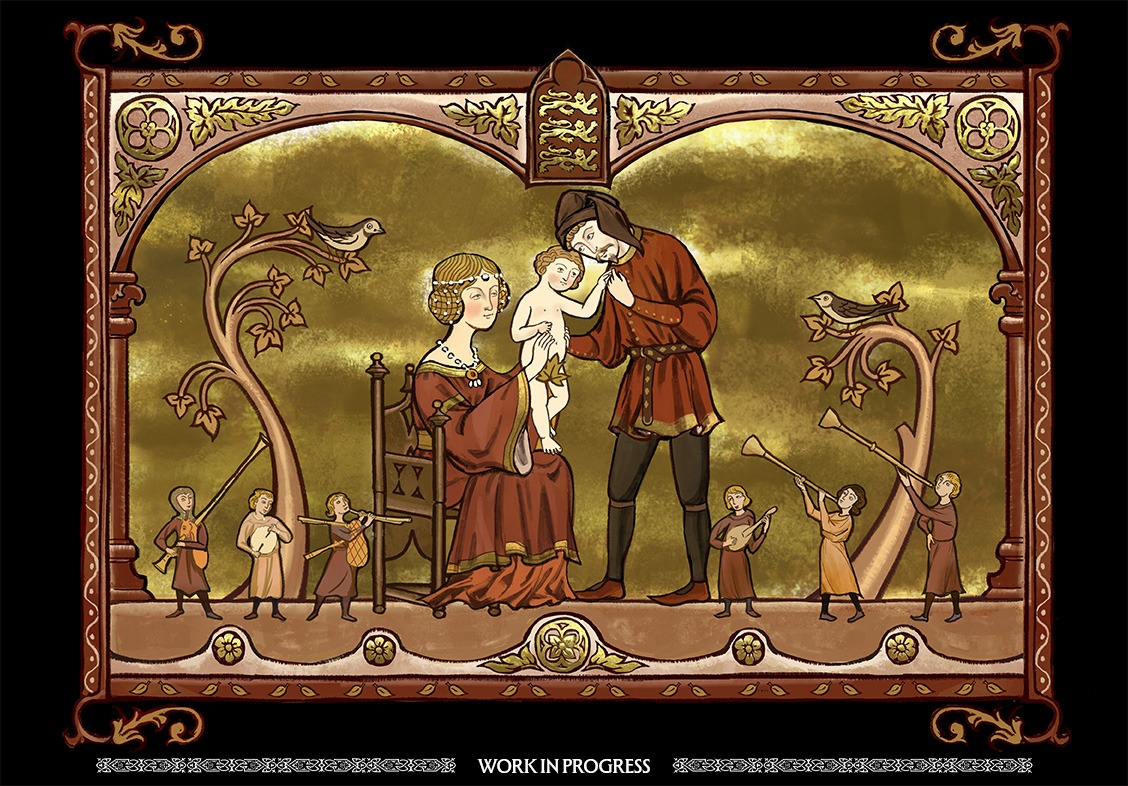
Please note that, although the systems described below form a core part of the experience in Chronicles: Medieval, their scope and values are still in active development, and subject to change and rebalancing.
Factions in Chronicles: Medieval
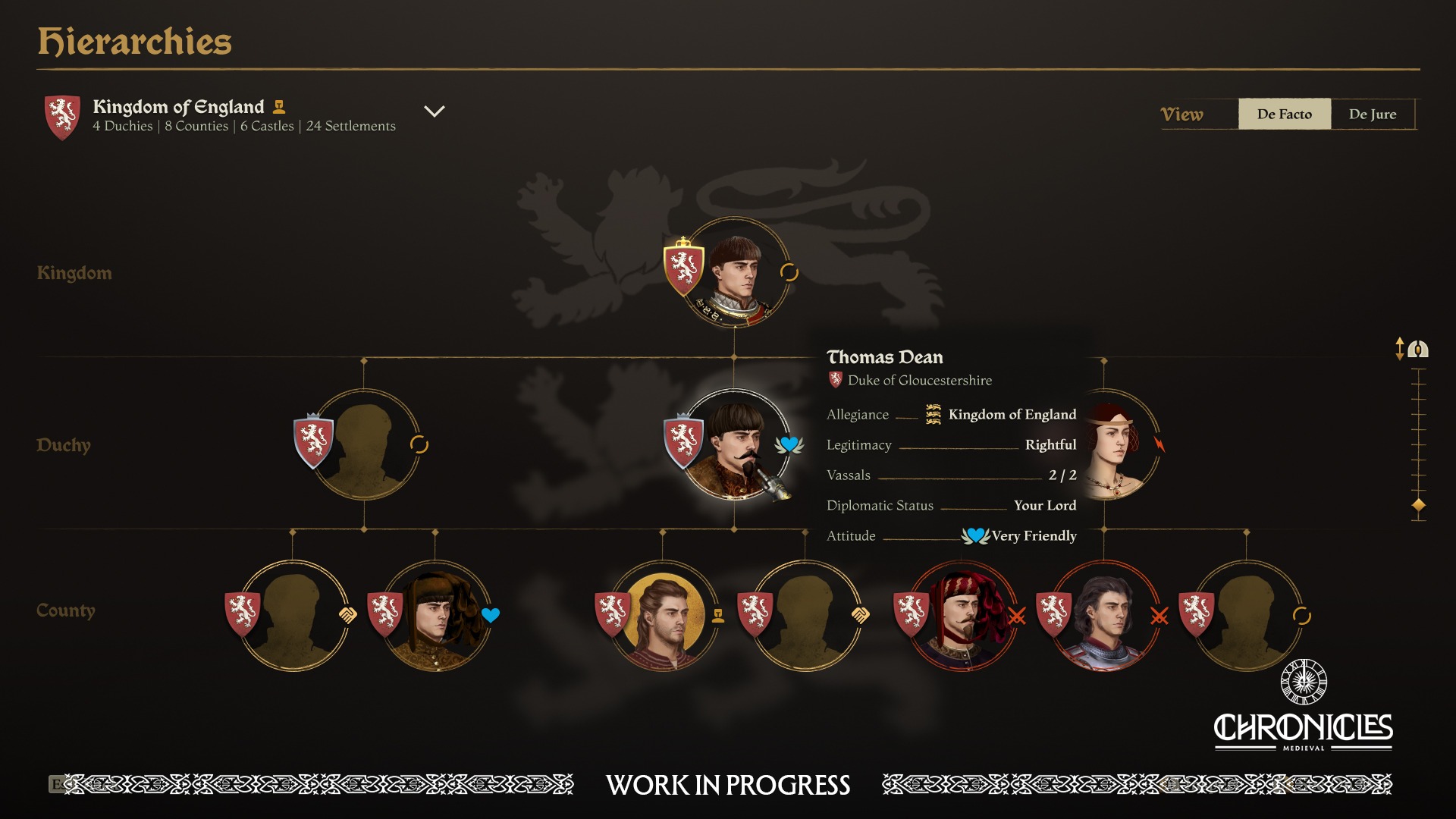
To represent this layer and move away from the more classic concepts of factions while deepening the game world, Chronicles: Medieval introduces the concept of titles. Among other things, titles have a rank and a type, which together place a character in a particular position within Chronicles: Medieval society.
The higher the rank of a character's highest title, the closer they sit to the top of the social hierarchy. From a common knight to an almighty emperor.
Type determines which kind of social hierarchy a title belongs to. These include the feudal nobility and the clergy, as well as merchants, artisans, mercenary bands, and so on. The focus of the Early Access experience will be centred on the feudal nobility.
Each title is also visually represented by heraldry. The arms of a character's highest-ranking title will be flown in full on the banners and standards of the armies and settlements they own.
Some titles are linked to settlements or regions of the game world. Holding such a title grants a character ownership over villages, castles, cities, regions, and so on, which become a vital source of income through taxation, alongside other revenues such as duties paid by vassals or trade. Ownership of all these different settlements will be available for Early Access.
A title can have one liege lord or none, and many vassals or none. These links, constrained by a title's rank, are what bring the factions of Chronicles: Medieval to life. A single faction can encompass the full range of nobility, from the lowliest knight to the most renowned emperor.
The world of Chronicles: Medieval is vast, and one person can only rule so much of it directly. In medieval times, the concepts of vassals and the decentralised nature of feudal rule meant that local lords held considerable power - sometimes more than the king himself. Chronicles: Medieval captures this through two related concepts: the domain limit and the vassal limit.
These limits are a soft cap, and if a character exceeds them they’ll receive a penalty to their income and their standing with their vassals.
Domain limit is concerned about the number of points of interest- settlements- ruled directly by a character. By exceeding what their personal domain limit allows, a character will suffer penalties to their income and to their standing with their vassals, who come to view them as hoarding land that should rightfully be granted out.
In parallel, the vassal limit encourages a character to consolidate the number of direct vassals beneath them; an organisation can only run so smoothly once it grows beyond a certain size. Exceeding the vassal limit incurs similar penalties to those of the domain limit.
At the start of the game, some titles aren’t held by any one character. These would be titles that no one held at that particular historical point, or that allow for alternative-history developments prompted by the evolving nature of the game’s world. For instance, creating the Kingdom of Wales (at this point, occupied by England as the Welsh Marches and the Principality) or the Duchy of York (created in 1385).
Only when a character meets a particular set of requirements, for example, holding some of the points of interest that make up a given region, will they be able to claim the title and become a force capable of unifying previously disparate groups. Title creation is therefore also a tool for managing one's realm: consolidating vassals within, and projecting strength without.
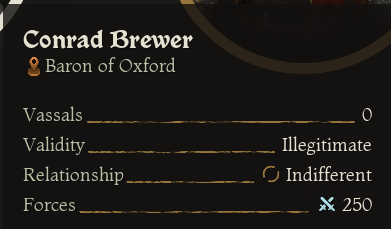
Ownership of a title can also be seen as more or less legitimate, on a scale from –100 to 100, from illegitimate to rightful. A character seen as legitimate will find it easier to retain their titles and to rally vassals to their aid. An illegitimate character is more vulnerable, as their allies and vassals will be reluctant to come to their defence in the face of external, or internal, aggression.
A character's legitimacy can also be measured against titles they do not currently hold. This marks them out as a claimant, and directly influences the support they can expect from vassals and allies should they attempt to press that claim by force. Equally, when a lord decides the time has come to grant a title to a loyal vassal, legitimacy will be a key factor in determining who should receive it. This way, maximising legitimacy, along relationship values, by helping out during wars, establishing alliances or sending gifts is an important tool in the expansion of your powerbase.
The factors affecting legitimacy include how long a character has held a title and how complete their ownership of the linked areas in the world is.
The titles present in the world of Chronicles: Medieval are historically plausible. Where concessions must be made (for the sake of gameplay, balance, and player agency, or simply because the historical record is silent), we draw from a broader time range, or from ideas closer to legend or alternative history. But the grounding is always historical and we are actively working with a historian to ensure that.
War and Peace in Chronicles: Medieval
Thanks to the title system, we are able to capture a great deal of the complexity of feudal politics. In this period, interpersonal relationships could, and quite often did, dictate policy. When you interact with a faction, you are dealing with individual characters, each pursuing their own ambitions. This means that befriending or allying with one noble within a faction does not automatically make you a friend to any other character within it. In fact, you may well find yourself drawn into its internal power struggle.
Diplomacy in Chronicles: Medieval is character-to-character. This captures the interpersonal diplomacy of the time period and brings a whole layer of depth to the world. Your personal relationship with a character will affect whether that character is willing to help or hinder you, with immediate effects on the political board and the field of battle.
As was so often the case historically, a great many titles in your name will count for little unless they are backed by the strength of loyal vassals and allies. Carefully weighing factors such as your standing with your vassals and how legitimate your rule is perceived to be is an essential step in assessing your true strength, and, tellingly, how vulnerable you are to attack from within or without.
A character's opinion of another character can be measured on a scale from –100 to 100: from absolute hatred to absolute love. This relationship value is the main indicator of whether a character is a friend or a potential threat. It is swayed one way or the other by the personal traits of the characters involved (a brave character, for instance, will tend to despise a cowardly one), and also by the specific actions a character takes for or against another. Sending gifts will improve a relationship value, whereas fighting someone, unsurprisingly, will make them love you rather less.
When a character deems it appropriate, they can declare war on another, rallying their vassals and allies against the armies of the enemy. They will be able to occupy their cities and castles, and disrupt their trade by attacking caravans carrying resources. Wars are always waged between two sides, each seeking to bring down the other.
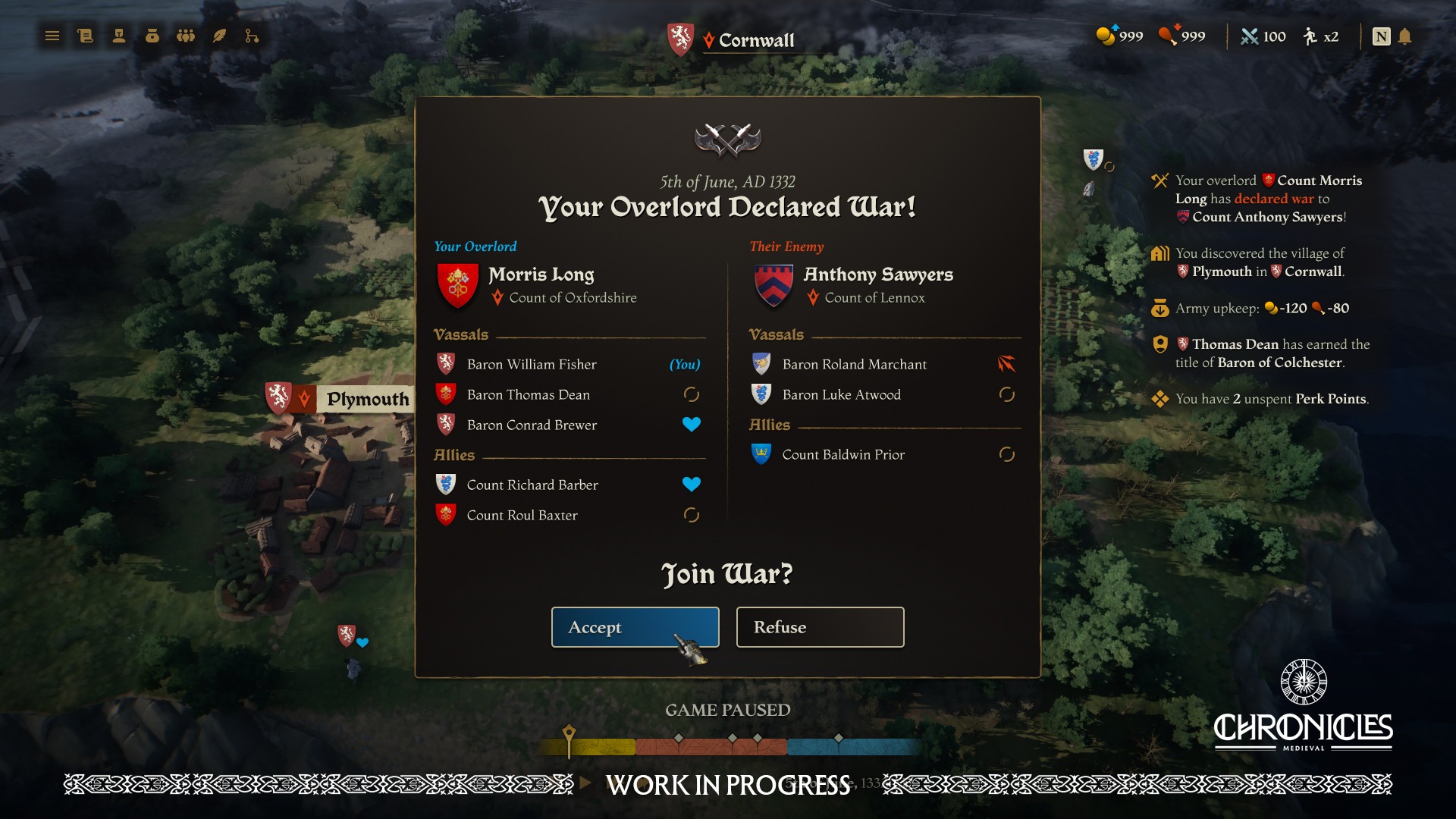
Raiding of enemy trade caravans, the casualties you inflict and sustain relative the size of standing armies; the occupied settlements you and your opponent control: these actions accumulate a warscore, which reflects how well the war is going for each side. This score is then used in the later peace negotiation step (described below) to enforce demands against the loser, whether in the form of titles and their associated lands, or in coin. After Early Access, the range of options can be expanded on.
Vassals, though expected to join their liege lord's wars, are not always immediately compelled to do so. They will weigh their chances between supporting a disliked liege lord now and facing his wrath later. They are also free to initiate wars of their own, expanding their domain independently, whether inside or outside the realm to which they belong, but if they are the aggressor then their liege lord may or may not come to their aid.
Although vassals enjoy a certain level of autonomy in fulfilling their duties, liege lords are more constrained in this regard, having a vested interest in protecting the lands of their vassals -which are, after all, the lands of their realm. Vassals will expect their liege lord's protection in exchange for the taxes they pay.
Allies, by contrast, are characters who have struck a deal with each other for mutual protection. They would have to like each other, and their military strength would need to be comparable to consider the advantages of an alliance. An alliance is formed to deter potential threats by combining the forces of those involved. Allies may, of course, fail to appear when the threat of war becomes reality. While this will damage how other characters view them, they generally have less at stake than a vassal would.
Once one side in a war has decided it is time to end hostilities, they may at any point compose a peace deal and send it to the enemy side for consideration. The enemy will then weigh whether the deal is agreeable, and accept or reject it accordingly.
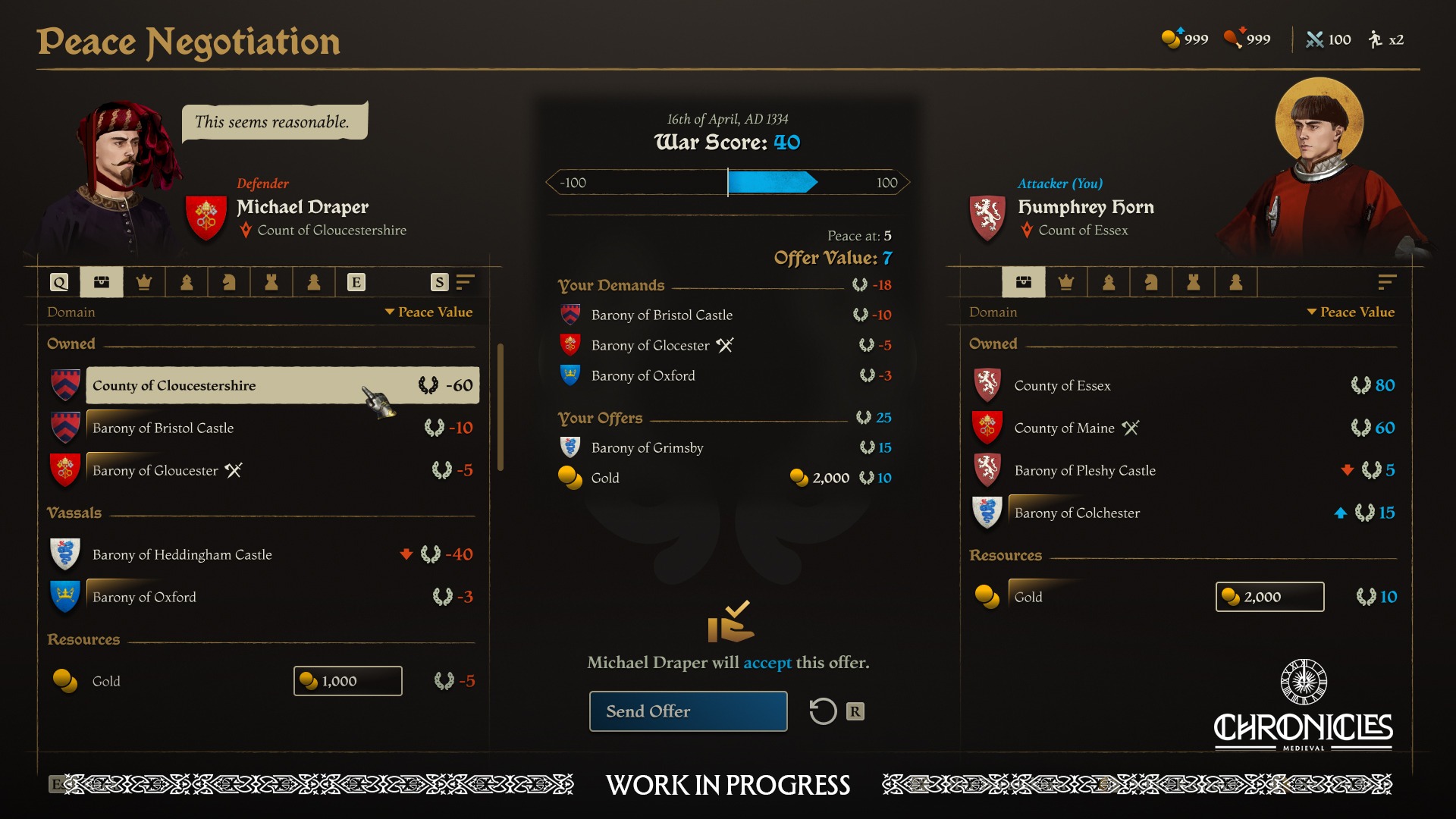
The winning side can enforce a deal on the losing side - if their offers continue to be rejected - once a certain warscore threshold has been reached. Beyond Early Access, we intend to expand the scope of what a peace treaty can encompass: independence, trade, and more - not simply the seizing of land and coin.
Once a peace deal has been agreed upon by both sides, the losing side is protected by a period of truce. This gives them time to breathe and rebuild. Truces cannot be broken without consequence: those who do so incur severe diplomatic penalties, as their neighbours come to view them as an unreliable threat.
The player in Chronicles: Medieval
The player will start from the bottom of the medieval social ladder and will have to become one of the rare cases that manages to eke out a name for themselves in the field of battle and in the realm of politics. History itself offers a handful of such figures. Men like Bertrand du Guesclin, a rough-mannered minor noble's son who fought and schemed his way to Constable of France, or William Marshal, a landless young knight who parlayed tournament glory into the regency of England - but they were the exception, not the rule.
Befriending the right person, helping them out, outmaneuvering rivals for the favor of a patron, and achieving glory in the field of battle, will be the way to climb the ranks, accumulate titles, and vassals to your banner.
I hope these lines have served you to better understand the world of Chronicles: Medieval and the ambitious goals the development has set out to achieve.
/ Álvaro, senior designer
Outro
What we hope comes through in all of this is that the systems aren't there for their own sake. They exist because the medieval world genuinely worked something like this, and because we believe the most interesting stories are the ones the period itself was already telling. A landless knight clawing their way up through service, and the occasional well-timed betrayal, is not a fantasy we invented. It's a story the fourteenth century told often, and rarely kindly.
We'll be back soon with more from the team. Until then - keep your vassals close, and your lord closer.

.jpg)
.jpg)

.jpg)